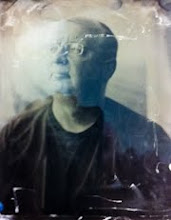
The internet is great for disseminating one's work, and it's great to learn about work being made by people you would probably never meet. I'm also learning that it's a useful networking tool within certain limits. But recent experiences confirm that for me (and others), it's important that art have a physical presence because of the ways that physicality can expand the experience for both artist and viewer.
I was recently discussing by e-mail a project that a photographer friend from San Francisco was working on, which involved taking a single subject (a tree) and exploring its form and meaning by different photographic approaches. She had initially been inspired to do so by the Wallace Stevens poem "Thirteen ways of looking at a blackbird". I suggested that she look at Jennifer Bartlett's work "In the Garden", which was a year-long project Bartlett did where she explored a somewhat mundane garden in the house she lived in for a year in France by making a series of paintings and drawings using different media, different perspectives and different scales. My friend found Bartlett's work to be helpful as her project developed, and she recently posted her first series of images as a 4X4 grid (as a working model for the presentation of the work). As we discussed the work further, I was struck by how rigid and limiting on-line presentations of images can be - there are very few decisions to be made with regard to final size of the work, differences in scale, differences in materials. We had an interesting discussion of how the impact of the work would change if it was hung as a series of installations in a gallery, with different scales, printed on different papers, some images isolated while others were grouped - all of these possibilities opening new avenues to explore the meaning of the work. Few of them are available with on-line presentation. Our discussion made me think a great deal of how these factors play into the presentation of my own work. Making the image, whether digitally or on film, is just the first step in a process that leads to the actual work whether its an online presentation or a physical one; there are just a lot more options to give meaning to the work with physical presentation.
I recently took some of my gravure proof prints and tintypes to a dinner party with friends. Two of the friends are collectors who have generously acquired a couple of pieces from me in the past. As they looked over the work, it was interesting to see how they appreciated the works as physical objects. We had an interesting discussion about the differences in scale of the gravure prints, Alex commenting that he actually preferred the smaller images that allowed him a more intimate feeling in looking at the work. Since both the 8X8 and 5X5 images were printed on 11X15 sheets of paper, this lead to a discussion of scale of the image within the scale of the substrate. As it turned out, because the gravure proofs were made in a workshop, I didn't have control over the size of paper available, and I found the discussion thought-provoking and timely as I have started printing a small series of kallitype images - what size should the image be, and on what size paper. These decisions affect a viewer's experience of the work in important ways.
During an e-mail correspondence, another friend mentioned that she really liked a tintype image I had posted on this blog of cherries in a copper bowl. I dropped in to visit with her a few days later, and brought that tintype along with a few others. It was wonderful to watch her pick them up and play with different angles of viewing them in the light. She mentioned that at first she had expected, really wanted them to be larger (the plates are 3.5 X 4.5) but that as she looked at them further she was beginning to like the smaller scale. She then went on to make a little mini-installation of 3-4 plates, which lead to a discussion of how one might display these tintypes that I found very useful. I enjoyed talking about the work with her, and learning from her reactions to the work how I might continue the project in terms of making additional images and ways to present the final work.
For me, these two experiences were far richer as a way of receiving feedback on my work, and of learning more about how my decisions on scale and presentation affect the viewer experience than any online interaction I've had over my work. It was the physicality of the tintypes and prints that were the foundation for this richer experience. I'm not about to abandon what the online platform offers in terms of interactions, broadening the audience for my work or finding interesting work by other artists. But I sense that for me and my work, that could never be enough.
Showing posts with label musings. Show all posts
Showing posts with label musings. Show all posts
Tuesday, August 30, 2011

Subscribe to:
Posts (Atom)